The Solution calculates water and electricity charges using a tiered tariff structure. The total water/ electricity usage for the billing period is allocated across the applicable tariff bands, starting with the lowest band and working upwards.
Each tariff band applies only to the portion of water/ electricity usage that falls within that specific band.
The Solution does not apply the highest tariff reached to the total water/ electricity usage.
Instead, the calculation works progressively through each tariff band until all the water/electricity usage has been allocated.
How the calculation works
The tariff bands can be thought of as a series of buckets. Each bucket can hold a specific amount of water/ electricity usage and has its own tariff.
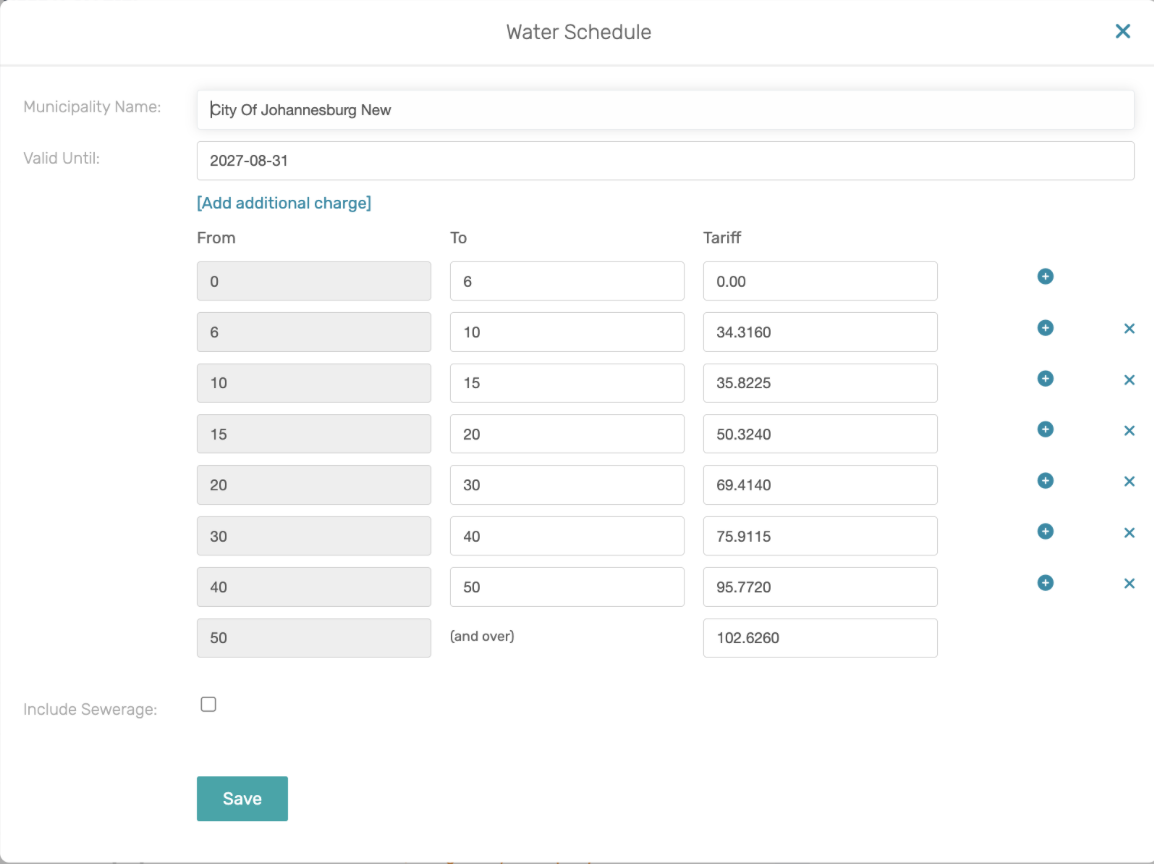
The Solution:
Starts with the lowest tariff band.
Allocates as much of the water/ electricity usage as that band allows.
Calculates the charge for the usage allocated to that band.
Moves to the next tariff band with the remaining usage.
Continues until all water/ electricity usage has been allocated.
Adds the charges from all applicable bands to calculate the total water/ electricity charge.
Note: The highest tariff band reached is not applied to the full water/ electricity usage. Only the units that fall within that band are charged at that tariff |
Example: 55 Units UsedIf the total water usage for the billing period is 55 units, the Solution works through each tariff band from lowest to highest. Band 1The first 6 units fall into Band 1. 6 × 0.0000 = R0.00 Band 1 is now full. 55 − 6 = 49 units remaining Band 2Band 2 can accommodate the next 4 units. 4 × 34.3160 = R137.26 49 − 4 = 45 units remaining Band 3Band 3 can accommodate the next 5 units. 5 × 35.8225 = R179.11 45 − 5 = 40 units remaining Band 4Band 4 can accommodate the next 5 units. 5 × 50.3240 = R251.62 40 − 5 = 35 units remaining Band 5Band 5 can accommodate the next 10 units. 10 × 69.4140 = R694.14 35 − 10 = 25 units remaining Band 6Band 6 can accommodate the next 10 units. 10 × 75.9115 = R759.12 25 − 10 = 15 units remaining Band 7Band 7 can accommodate the next 10 units. 10 × 95.7720 = R957.72 15 − 10 = 5 units remaining Band 8Band 8 applies to usage above 50 units. The remaining 5 units therefore fall into Band 8. 5 × 102.6260 = R513.13 5 − 5 = 0 units remaining There is no remaining usage to allocate. The charges from all eight bands are added together:
Water charge: 3,492.10 |
Key points to remember
Water/ Electricity usage is allocated to tariff bands from the lowest band upwards.
Each band is charged only for the units that fall within that band.
Once a band reaches its maximum allocation, the remaining usage moves to the next band.
The highest tariff reached is not applied to the total water usage.
The charges from all applicable bands are added together to determine the final water/ electricity charge.
If the total usage does not reach a particular band, that band is not included in the calculation.
A tariff band may therefore contain only a portion of the total water usage.
Was this article helpful?
That’s Great!
Thank you for your feedback
Sorry! We couldn't be helpful
Thank you for your feedback
Feedback sent
We appreciate your effort and will try to fix the article